Skip to navigation
Skip to main content


Articles
Home » Articles » Research & Evidence » What Is Sea Buckthorn Good For? 7 Potential Benefits and What the Evidence Says
What Is Sea Buckthorn Good For? 7 Potential Benefits and What the Evidence Says

Short answer: sea buckthorn is a nutrient-dense orange berry. It is one of very few plant sources of Omega-7, and it also contains Omega 3, 6 and 9, vitamins A, C, E and K, carotenoids and polyphenols. Researchers are studying it for skin health, antioxidant intake and blood lipids. The evidence is promising in places but still early, so treat sea buckthorn as good nutrition, not as a treatment.
Sea buckthorn (Hippophae rhamnoides), also called seaberry or buah beri buckthorn in Malay and 沙棘 in Chinese, grows wild across the highlands of Central Asia, the Himalayas and the Tibetan Plateau. In Malaysia you will usually find it as sea buckthorn juice, powder, pulp oil or seed oil. Each form gives you a different mix of nutrients, which matters when you compare products.
Below are seven potential benefits, what the research actually shows for each, and how to choose a sea buckthorn supplement in Malaysia.
What is in sea buckthorn?
- Omega-7 (palmitoleic acid): found mainly in the pulp oil. Very few foods contain it in meaningful amounts.
- Omega 3, 6 and 9: mainly in the seed oil.
- Vitamins: A (as carotenoids), C, E and K.
- Plant compounds: carotenoids, flavonoids and other polyphenols.
How much of each you get depends on which part of the berry is used and how it is processed. A juice is not the same as a standardised oil.
7 potential health benefits of sea buckthorn
1. Skin health and hydration
Sea buckthorn oil contains palmitoleic acid, an Omega-7 fatty acid that is naturally part of the skin’s lipid layer. That is why it appears in so many skincare products. Researchers are studying whether taking it by mouth supports skin hydration and elasticity, but evidence that a drink or supplement improves skin or reduces wrinkles is still limited.
2. Omega-7 nutrition
Sea buckthorn is one of the richest plant sources of Omega-7. Omega-7 is of interest to researchers studying lipid metabolism, but it is far less studied than Omega-3. If Omega-7 is the reason you are buying, check the label for the stated Omega-7 or palmitoleic acid content rather than assuming every sea buckthorn product has the same amount.
3. Antioxidant intake
The berry naturally contains polyphenols, carotenoids and vitamins C and E. Antioxidants help protect cells from oxidative damage under normal conditions. A varied diet of fruit and vegetables is the main way to get them. A high antioxidant content on its own does not prove a specific health benefit.
4. Blood lipids and cardiovascular wellness
This is the most researched area. A 2017 meta-analysis by Guo and colleagues, published in Trends in Food Science & Technology, pooled 11 randomised controlled trials with over 900 participants. It found improvements in total cholesterol, triglycerides and HDL cholesterol, but only in people who already had high blood lipids or other cardiovascular risk factors. In healthy people there was no significant effect. The authors called for larger and longer trials.
Some smaller studies have looked at blood pressure, but the results are not consistent enough to draw conclusions. Sea buckthorn is not a substitute for prescribed medication or for proven steps such as diet, exercise and regular check-ups.
5. Nutrition for healthy ageing
Sea buckthorn’s mix of fatty acids, vitamins and plant compounds makes it a nutrient-dense addition to a balanced diet. There is not enough evidence to say it slows ageing or prevents age-related disease.
6. Everyday wellness for women and men
Sea buckthorn is used by adults of all ages and genders. There is currently not enough evidence to claim benefits unique to men or to women. Whether it suits you depends on the formulation, your health and any medication you take.
7. A convenient way to add variety to your diet
For busy and active people, a daily sea buckthorn drink or sachet is an easy way to add a nutrient-dense fruit to the day. It works best alongside good food, regular exercise and enough sleep, not instead of them.
Omega-3 vs Omega-7: what is the difference?
Omega-3 fatty acids such as EPA and DHA come mainly from oily fish and fish oil. Omega-7, mainly palmitoleic acid, is a different fatty acid found in very few foods, with sea buckthorn and macadamia among the best-known plant sources. They have different nutritional properties and are not interchangeable, which is why some people take both.
Sea buckthorn juice, powder or oil: which is best?
- Sea buckthorn juice: easy to drink and naturally tart, but Omega-7 content is usually low and not stated. Check for added sugar.
- Powder or sachets: convenient and portable. Quality depends on whether the oil is included and standardised.
- Pulp oil capsules: the most concentrated Omega-7 source, though some people dislike swallowing oil capsules.
- Seed oil: richer in Omega 3 and 6 than in Omega-7.
How to choose a sea buckthorn supplement in Malaysia
- Check the Omega-7 content. A standardised percentage of palmitoleic acid tells you what you are paying for.
- Check the form. Juice, powder, pulp oil and seed oil have different profiles.
- Look for certifications. For many Malaysian buyers that means Halal (JAKIM or a state authority such as JAIS), and vegan if you avoid gelatin capsules.
- Read the full ingredient list. Watch for added sugar, colours and fillers.
- Look for independent testing. If you compete in sport, banned-substance screening matters.
- Check the manufacturer and serving size so you can compare cost per day, not just price per box.
Is sea buckthorn safe to take every day?
Sea buckthorn is eaten as a food in many countries and is generally well tolerated by healthy adults. Daily use depends on the product, the recommended serving on the label and your own health. Speak to a healthcare professional first if you are pregnant or breastfeeding, have a medical condition, or take medication, especially blood thinners or medicines for blood pressure or cholesterol.
An example: CardiBerry Sea Buckthorn Omega-7
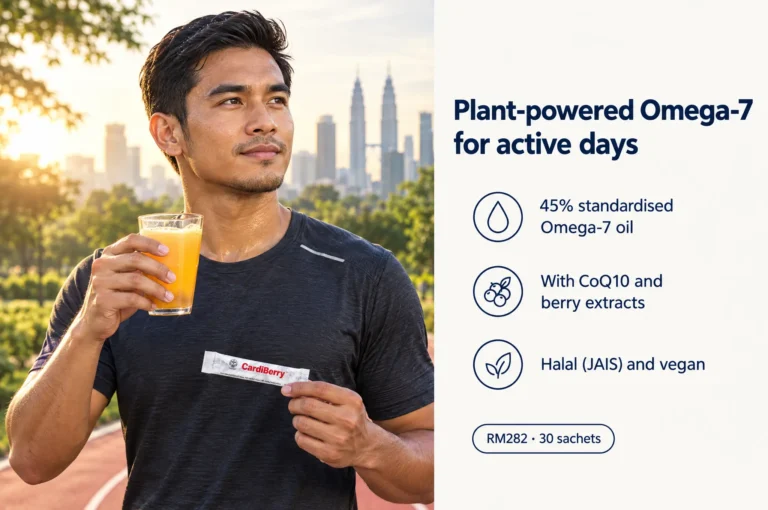
If you want a convenient daily option, CardiBerry Sea Buckthorn Omega-7 is a sachet drink built on CardiOmegia, a sea buckthorn oil standardised to 45% palmitoleic acid (Omega-7), with CoQ10, goji berry, strawberry and cranberry. It is Halal (JAIS), vegan and has no added sugar. A tested batch was screened by Institut Sukan Negara for 100 WADA-listed prohibited substances, with none detected. Each 4g sachet mixes with 40ml of water or can be taken directly, one or two sachets a day after a meal. A box holds 30 sachets. Follow the serving on the product label.
See CardiBerry on ReserveDaily
Frequently asked questions
What is sea buckthorn good for?
Sea buckthorn is valued for its nutrition: Omega 3, 6, 7 and 9, vitamins A, C, E and K, carotenoids and polyphenols. It is being studied for skin health, antioxidant intake and blood lipids. Evidence for specific health outcomes is still limited, so it is best seen as part of a varied, balanced diet.
Does sea buckthorn lower blood pressure?
Researchers have studied sea buckthorn and blood pressure, but the results are not consistent and the evidence is not strong enough to say it lowers blood pressure. It should not replace prescribed medication. If you have high blood pressure, follow your doctor’s advice.
Does sea buckthorn lower cholesterol?
A 2017 meta-analysis of 11 randomised trials found improvements in total cholesterol, triglycerides and HDL cholesterol in people who already had high blood lipids, but no significant effect in healthy people. Larger and longer studies are still needed. Sea buckthorn is not an established treatment for high cholesterol.
What is the difference between Omega-3 and Omega-7?
Omega-3 includes EPA and DHA, mostly from fish oil. Omega-7, mainly palmitoleic acid, is a different fatty acid found in very few foods, with sea buckthorn among the richest plant sources. They have different properties and are not interchangeable.
Can I take sea buckthorn every day?
Many healthy adults take sea buckthorn daily as a food supplement. Follow the serving on the product label and speak to a healthcare professional first if you are pregnant, breastfeeding, have a medical condition or take medication.
Where can I buy sea buckthorn in Malaysia?
Sea buckthorn is sold in Malaysia as juice, powder, sachets and oil capsules through pharmacies and online stores. ReserveDaily stocks CardiBerry Sea Buckthorn Omega-7, a Halal and vegan sachet drink, with delivery across Malaysia including Sabah and Sarawak.
Important information: this article is for general education and is not medical advice. Sea buckthorn is a nutritional ingredient, not an established treatment for hypertension, diabetes, high cholesterol or cardiovascular disease. Food supplements are not intended to diagnose, treat, cure or prevent any disease. Consult a qualified healthcare professional before using supplements if you have a medical condition or take medication.
Reference: Guo X-F and colleagues, a meta-analysis of 11 randomised controlled trials on sea buckthorn and blood lipids, Trends in Food Science & Technology, 2017, volume 61, pages 1 to 10.
What Is Sea Buckthorn Good For? 7 Potential Benefits and What the Evidence Says