

Home » Articles » Research & Evidence » Exosome Therapy for Hair Loss: Which Norwood Stage Responds Best?
Exosome Therapy for Hair Loss: Which Norwood Stage Responds Best?

Exosome therapy tends to work best on early to moderate hair thinning, roughly Norwood stages 2 to 4, where hair follicles are miniaturising but still present and biologically active. In more advanced hair loss, Norwood stage 5 and above, where large areas have no active follicles left, exosome therapy has much less to work with, and is generally more honestly positioned as a support treatment alongside other options rather than a standalone solution.
The Norwood Scale, Explained Simply
The Norwood scale is the standard way clinicians and patients describe the pattern and progression of male pattern hair loss, running from stage 1, no visible loss, through stage 7, extensive loss with only a horseshoe shaped band of hair remaining around the sides and back.
| Stage | What it typically looks like | Exosome therapy fit |
|---|---|---|
| 1 | No visible hairline recession | Not applicable, no active loss to treat |
| 2 | Slight recession at the temples | Strong candidate |
| 3 | Deeper temple recession, early crown thinning may begin | Strong candidate |
| 4 | Clear crown thinning with a defined recessed hairline | Good candidate, best results with early treatment |
| 5 | Crown and frontal areas begin to merge | Limited candidate, response varies |
| 6 | Crown and frontal balding largely connected | Poor candidate as a standalone treatment |
| 7 | Only a horseshoe band of hair remains | Not a realistic standalone option |
This table is a useful shared reference point precisely because it aligns expectations before any conversation about treatment begins. A stage 2 patient and a stage 6 patient are asking the same question, will this work for me, but the honest answer is different for each of them, and the scale is what makes that difference explainable rather than vague.
How Exosome Therapy Works for Hair Restoration
Exosomes used in hair applications carry growth factors and signalling molecules thought to support the follicle environment and surrounding scalp tissue. The therapy is typically applied via injection or topical application directly to the scalp, often across a series of sessions rather than a single visit. The underlying premise is straightforward: a follicle that is still present but producing thinner, shorter, or slower growing hair has biological machinery worth supporting. A follicle that has been dormant for years, with no visible growth at all, may no longer have that machinery intact, which is the central reason stage matters so much to the outcome.
In practical terms, the treatment aims to extend the growth phase of the hair cycle and support blood flow to the follicle, rather than creating new follicles where none exist. This distinction is why the stage table above matters more for this treatment than it does for, say, a topical product that simply coats existing hair. Exosome therapy is working with what is biologically still there, not manufacturing new starting material. It is also why two patients at the same stage can respond differently, since the number and health of remaining active follicles varies by individual even within the same Norwood classification, which is one more reason an in person assessment matters more than the stage number alone.
What Happens During a Consultation
A proper consultation before this treatment should include more than a visual glance at your hairline. A practitioner assessing candidacy typically looks at the pattern and density of thinning across the whole scalp, not just the most visible areas, checks for signs of active shedding versus stable thinning, and may use a handheld trichoscope to examine individual follicles at magnification. Some practitioners also ask about family history and how quickly the thinning has progressed, since a rapid recent change points to a different underlying process than a slow, decades long recession. This assessment is what actually determines your position on the stage table above, not a self assessment from a mirror or a photo, and it is also what should determine whether exosome therapy alone is a reasonable recommendation for you specifically.
Best Candidates: Norwood Stage 2 to 4
At these stages, follicles are typically still present and producing hair, just thinner and shorter than before. This is the biological target exosome therapy is best suited to support, and it is also the stage range where starting early, rather than waiting to see how much worse things get, tends to produce the most favourable outcomes. Waiting from stage 2 to stage 5 does not just mean more hair loss to reverse. It can mean the difference between follicles that are still working and follicles that have shut down entirely. Patients in this range are also the group most likely to see a meaningful response from combining exosome therapy with other approaches, covered below.
Limited Response: Norwood Stage 5 to 7
Once an area has been visibly bald for an extended period, the follicles there are often no longer active, and no regenerative treatment, exosomes included, can stimulate hair growth from a follicle that is no longer present or functioning. For these stages, a hair transplant is usually the more realistic path to visible density, sometimes combined with exosome therapy afterward to support the health of the transplanted follicles and surrounding scalp. A practitioner who tells a stage 6 patient that exosome therapy alone will restore a full head of hair is not giving an honest assessment, and that gap between marketing promise and biological reality is exactly why it is worth asking whether a specific claim is realistic before booking. This does not mean stage 5 to 7 patients have no options. It means the honest options are different, and usually involve a combination approach rather than exosome therapy alone.
Combining Exosomes with Minoxidil or Finasteride
Many practitioners recommend pairing exosome sessions with an ongoing minoxidil or finasteride routine, since the two approaches work through different mechanisms. Minoxidil and finasteride primarily address the hormonal and vascular drivers of hair loss over the long term, while exosomes are thought to support the local follicle and scalp environment more directly. Used together, the combination is generally considered more likely to produce a visible result than either approach alone, particularly for patients already in the stage 2 to 4 range where both treatments have something meaningful to work with. A practitioner may also suggest sequencing rather than starting everything at once, for example establishing a minoxidil or finasteride routine first and adding exosome sessions once that foundation is in place, though approaches vary and this is a conversation to have directly with whoever is treating you.
What Results to Expect, and When
Realistic timelines run in months, not weeks. Some patients report early changes in shedding or scalp condition within the first four to eight weeks, often described as hair feeling less prone to coming out during washing or brushing rather than any visible density change yet. More visible density changes, where they occur, typically take three to six months, and sometimes longer, since a hair follicle that is stimulated to grow still has to complete a normal growth cycle before the result is visible above the scalp. Response varies significantly by individual, and not everyone responds the same way even within the same Norwood stage, which is why the consultation described above matters more than the stage number alone. A practitioner who promises a specific timeline or outcome before assessing your scalp in person is describing something the evidence does not support.
Exosome Therapy vs. Hair Transplant: When Each Makes Sense
Exosome therapy is generally best understood as an early intervention or supportive treatment, not a replacement for a transplant once an area is fully bald. For patients with significant, established hair loss who want a defined, visible change, a transplant combined with post-procedure exosome support is often the more honest conversation to have with a practitioner, rather than being sold exosome therapy alone as a complete solution for advanced baldness.
The two treatments are not really competing for the same patient in most cases, they solve different problems. A transplant physically relocates existing follicles from a donor area to a balding area, which is why it can produce visible density even in a fully bald zone where no biological activity remains to stimulate. Exosome therapy cannot do this, since it only works with follicles that already exist and are still capable of responding. Where the two genuinely do overlap is in the months after a transplant, where some practitioners use exosome sessions to support the transplanted follicles while they settle into their new location, and in patients who are not yet ready for a transplant but want to slow further loss while they decide.
What This Looks Like as an Actual Treatment
ReserveDaily lists several hair specific products at different points on this spectrum.
None of these substitute for an in person assessment of your specific stage and scalp condition, but they illustrate the practical range between a low commitment starting point and a more intensive clinical protocol.
Find the right hair treatment for your stage
ReserveDaily lists at-home and in-clinic exosome hair options from vetted clinical partners in Malaysia, with the price shown upfront on every listing.
Browse regenerative care listings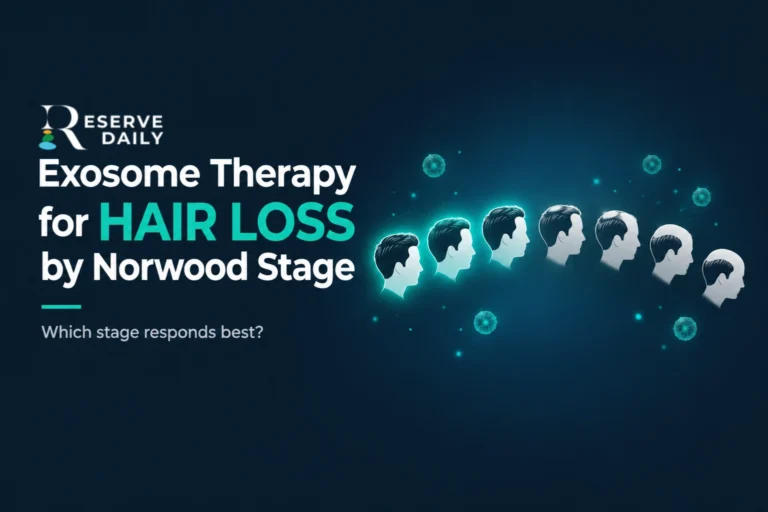
Exosome Therapy for Hair Loss: Which Norwood Stage Responds Best?