




ORIGENE Genetic Wellness Screening
RM1,900.00 package
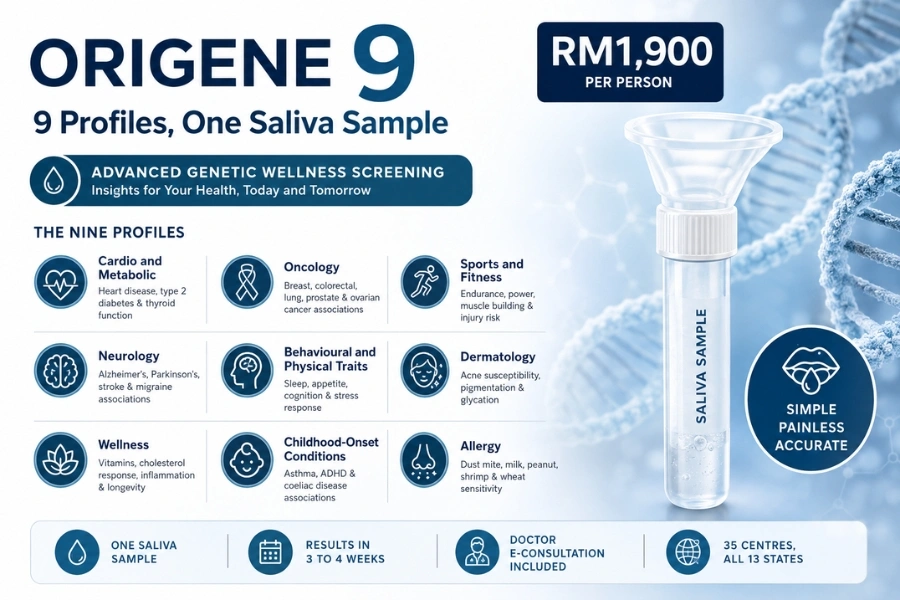
Genetic screening in Malaysia reading your DNA from one saliva sample and reporting 249 named traits and conditions across nine profiles, with no blood draw and no fasting.
Every one of the 249 is listed below, profile by profile.
ORIGENE Genetic Wellness Screening 9 Profiles, 249 Traits, One Saliva Sample
A genetic screening in Malaysia reading your DNA from one saliva sample and reporting 249 named traits and conditions across nine profiles, with no blood draw and no fasting. Every one of the 249 is listed below, profile by profile.
Your DNA does not change, so this is a test you take once. What changes over time is the interpretation, as the research base grows, which is why a report should be read as the current available reading rather than a permanent verdict.
| Profile | Traits | What it reports |
|---|---|---|
| Derma | 21 | Skin, hair and pigmentation traits, from acne and eczema to collagen integrity, sun response and keloid tendency |
| Wellness | 49 | The widest profile. Micronutrient handling, cholesterol fractions, inflammation, joint and eye conditions, intolerances and longevity |
| Sports and Fitness | 50 | Training response, macronutrient handling, injury risk and weight management, reported in 13 named sub-groups |
| Behavioural and Physical Traits | 37 | Sleep, appetite, cognition, personality and hair traits. Read these as the softest evidence on the report |
| Cardio and Metabolic | 21 | Heart, vascular, thyroid and metabolic conditions, including both diabetes types and fatty liver disease |
| Onco | 35 | Common-variant associations for 35 cancer entries, including sex-specific pairs. Not a hereditary cancer gene panel |
| Neuro | 7 | Seven neurological and psychiatric conditions |
| Allergy Profile | 8 | Eight genetic allergy associations. This reports tendency, not current sensitisation, and does not replace an IgE blood panel |
| Childhood-Onset Diseases | 21 | Conditions that present in childhood, from asthma and ADHD to coeliac disease and Long QT syndrome |
| Total reported · 249 traits and conditions across 9 profiles | ||
Two profiles carry most of the report. Wellness at 49 and Sports and Fitness at 50 together account for 99 of the 249, so if neither interests you, you are paying RM1,900 for a good deal less than the headline suggests. Onco is the profile people buy this for, and it is the one to read carefully: it reports common-variant associations, it is not a hereditary cancer gene panel, and it includes sex-specific pairs, so a woman’s report lists both Prostate Cancer (Female) and Prostate Cancer (Male). The laboratory’s own recommendation against a raised male breast cancer entry is to have female relatives screened for BRCA1 and BRCA2, which is the clearest possible statement that this test is not that test.
| Profile | What is reported |
|---|---|
| Derma · 21 | Acne Risk, Body Odor (Bromhidrosis), Cellulite, Collagen Integrity, Dry Skin, Eczema (Atopic Dermatitis), Folate-Folic Acid Deficiency, Freckles, Generalized Psoriasis, Glycation Protection, Keloid Risk, Melanin and Pigmentation, Omega-3 and Omega-6 Deficiency, Premature Wrinkles, Response to Antioxidants, Skin Barrier, Skin Elasticity, Skin Lightening Ability, Sunspots, Tanning Response, Varicose Veins |
| Wellness · 49 | Achilles Tendinopathy, Adiponectin Level, Ankylosing Spondylitis, Anterior Cruciate Ligament (ACL) Rupture, Caffeine Metabolism, Calcium Metabolism, Carbohydrate Metabolism, Carotene Level, CoEnzyme Q10, Collagen Formation, Concussion, Detoxification Capacity, Endurance Sports Performance, Energy Utilization, Glaucoma, Gluten Sensitivity, Hay Fever, HDL Cholesterol, High Blood Sugar (Hyperglycemia), High Triglycerides, Homocysteine Metabolism, Inflammatory Response, Lactose Intolerance, LDL Cholesterol, Longevity, Maximal Oxygen Consumption (VO2 Max), Osteoarthritis, Osteoporosis, Pain Tolerance, Polyunsaturated Fatty Acids, Power Sports Performance, Respiratory Infection – Severity, Respiratory Infection – Susceptibility, Rheumatoid Arthritis, Salt-Sensitivity High Blood Pressure, Selenium, Soft Tissue Injury, Sports Induced Sudden Cardiac Arrest, Steroid Hormones Metabolism, Stress Sensitivity, Total Cholesterol, Vision Degeneration, Vitamin A, Vitamin B2, Vitamin B6, Vitamin B12, Vitamin C, Vitamin D, Vitamin E |
| Sports and Fitness · 50 | Bone and Joint Health: Achilles Tendinopathy, Bone and Joint Health: Anterior Cruciate Ligament (ACL) Rupture, Bone and Joint Health: Calcium Metabolism, Bone and Joint Health: Osteoarthritis, Bone and Joint Health: Osteoporotic Fractures, Bone and Joint Health: Vitamin D, Energy Metabolism and Utilization: Dietary Choline Tendency, Energy Metabolism and Utilization: Phosphorus Metabolism, Energy Metabolism and Utilization: Vitamin B12, Energy Metabolism and Utilization: Vitamin B6, Energy Metabolism and Utilization: Vitamin B9 Folate Tendency, Macronutrient Metabolism: Carbohydrate Utilization, Macronutrient Metabolism: Cholesterol Response to Dietary Fat, Macronutrient Metabolism: Fat Utilization, Macronutrient Metabolism: Insulin Response to Dietary Fat, Macronutrient Metabolism: Polyunsaturated Fat Metabolism, Macronutrient Metabolism: Protein Utilization, Macronutrient Metabolism: Vitamin E, Mental Ability and Performance: Impulse Control and Taste Preference, Mental Ability and Performance: Intrinsic Motivation to Exercise, Mental Ability and Performance: Sleep Duration, Mental Ability and Performance: Stress Sensitivity, Muscle Building Capacity: Testosterone, Muscle Building Capacity: Zinc Metabolism, Muscle Performance: Copper Metabolism, Muscle Performance: Iron Metabolism, Muscle Performance: Magnesium Metabolism, Oxidative Stress Metabolism: Antioxidants, Oxidative Stress Metabolism: CoEnzyme Q10, Oxidative Stress Metabolism: Vitamin A, Oxidative Stress Metabolism: Vitamin C, Response to Cardiovascular Training: Exercise Heart Rate Response, Response to Cardiovascular Training: Fat Loss Response to Cardio, Response to Cardiovascular Training: Fitness Response to Cardio, Response to Cardiovascular Training: Glucose Response to Cardio, Response to Cardiovascular Training: HDL Response to Cardio, Response to Cardiovascular Training: Insulin Sensitivity Response to Cardio, Response to Cardiovascular Training: Triglycerides Response to Cardio, Response to Resistance Training: Body Composition, Response to Sports Drinks: Caffeine Metabolism, Response to Sports Drinks: Lactose Metabolism, Sports-Induced Injury Risk: Concussion, Sports-Induced Injury Risk: Soft Tissue Injury, Training Modes and Energy: Endurance Capacity, Training Modes and Energy: Energy Utilization, Training Modes and Energy: Exercise Intensity Power Capacity, Weight Management: Weight and Satiety, Weight Management: Weight Loss Metabolism, Weight Management: Weight Loss Tendency, Weight Management: Weight Regain Tendency |
| Behavioural and Physical Traits · 37 | Ability To Memorize, Addictive Personality, Alcohol Dependence, Alcohol Flush, Appetite Regulation, Body Volume (Hair), Body Hair, Emotional Quotient (EQ), Extroversion, Food Addiction, General Cognitive Ability, Hair Dryness or Brittleness, Hair Graying, Hair Thickness, Hair Thinning, Hair Type, Harm Avoidance Behaviour, Information Processing Power, Insomnia, Instant Gratification, Intelligence Quotient (IQ), Lumbar Disc Disease (Lower Back Pain), Male Pattern Baldness, Memory Skills, Monobrow, Motion Sickness, Nicotine Dependence, Optimism and Empathy, Positive Affectivity, Reading and Spelling, Reward Dependence, Sensitive Personality, Sleep Depth, Sleep Duration, Sleep Latency, Sleep Quality, Sweet Tooth |
| Cardio and Metabolic · 21 | Abdominal Aortic Aneurysm, Arrhythmogenic Right Ventricular Dysplasia, Atrial Fibrillation, Chronic Obstructive Pulmonary Disease, Coronary Heart Disease, Deep Vein Thrombosis and Pulmonary Embolism, Dilated Cardiomyopathy, Dyslipidemia, Gallstone, Gestational Diabetes, Gout, Grave’s Disease (Hyperthyroidism), Heart Attack, Hypertension, Hypothyroidism, Metabolic Syndrome, Non-Alcoholic Fatty Liver Disease, Obesity, Peripheral Arterial Disease, Type 1 Diabetes, Type 2 Diabetes |
| Onco · 35 | Acute Lymphoblastic Leukemia, Basal Cell Carcinoma, Bladder Cancer, Breast Cancer (Female), Breast Cancer (Male), Cervical Cancer (Female), Cervical Cancer (Male), Chronic Lymphocytic Leukemia, Colorectal Cancer, Endometrial Cancer (Female), Endometrial Cancer (Male), Esophageal Cancer, Gallbladder Cancer, Glioma Development (Brain Tumor), Hepatocellular Carcinoma (Liver Cancer), Hodgkin’s Lymphoma, Kidney Cancer, Laryngeal Cancer, Lung Cancer, Melanoma, Meningioma, Nasopharyngeal Cancer, Non-Hodgkin’s Lymphoma, Oral and Throat Cancers, Osteosarcoma, Ovarian Cancer (Female), Ovarian Cancer (Male), Pancreatic Cancer, Prostate Cancer (Female), Prostate Cancer (Male), Squamous Cell Carcinoma of the Skin, Stomach Cancer, Testicular Germ-Cell Tumor (Female), Testicular Germ-Cell Tumor (Male), Thyroid Cancer |
| Neuro · 7 | Alzheimer’s Disease, Brain Aneurysm, Depression, Epilepsy, Migraine Headache, Parkinson’s Disease, Stroke |
| Allergy Profile · 8 | Allergy to Cats, Allergy to Dust Mites, Allergy to Grass, Allergy to Metal (Nickel), Allergy to Milk, Allergy to Peanuts, Allergy to Shrimp, Allergy to Wheat |
| Childhood-Onset Diseases · 21 | Adolescent Idiopathic Scoliosis, Allergic Rhinitis, Asthma, Attention-Deficit Hyperactivity Disorder (ADHD), Celiac Disease, Childhood Epilepsy, Crohn’s Disease, Dyslexia, Early Speech Development, Invasive Pneumococcal Disease, Juvenile Idiopathic Arthritis, Kawasaki Disease, Long QT Syndrome, Meningococcal Disease, Obesity (Childhood Onset), Obsessive-Compulsive Disorder (OCD), Pathological Myopia, Restless Legs Syndrome, Teething, Tourette Syndrome, Ulcerative Colitis |
This is the laboratory’s own list, published in full so you can check whether the thing you are curious about is actually on the panel before you pay. Every entry returns a band rather than a number: reduced, normal or increased risk, lower or higher tendency, and so on. The report names the gene and your genotype behind each finding, for example TPH2 or OXTR against stress sensitivity, so the result is traceable rather than a black box. Note that some entries appear in more than one profile under different framing, such as vitamin D in both Wellness and Sports and Fitness.
This is not a hereditary cancer gene panel and it does not test BRCA1 or BRCA2 to clinical standard. If cancer runs in your family, ask us about clinical genetic testing with counselling rather than buying this.
It is not carrier screening for family planning, it is not a prenatal test, and it is not a paternity or ancestry test.
It is not a measurement of your current health. Genetics describes tendency; blood work describes state. If you have never had a basic screening, that is the more useful first RM126 to spend.
How It Works
 1
1 2
2 3
3 4
4Collected at 35 partner centres nationwide and processed in Malaysia by an accredited specialty genomics laboratory, so the sample does not leave the country. Every report is read by a doctor registered with the Malaysian Medical Council before the e-consultation. Variant panels and the risk models applied to them differ between providers, so a report from this test is not interchangeable with one from another company.
Consumer genetic wellness reports rest largely on common variants and polygenic scores, and the open catalogue of those scores together with their evaluation framework is maintained as a public resource (Lambert SA, et al. Nat Genet. 2021;53(4):420 to 425. doi.org/10.1038/s41588-021-00783-5). Three limitations belong on the page rather than in the small print. Polygenic scores transfer poorly across ancestries, because most were derived in cohorts of European ancestry, and an international task force set out both the potential and the gaps in clinical use (Polygenic Risk Score Task Force of the International Common Disease Alliance. Nat Med. 2021;27(11):1876 to 1884. doi.org/10.1038/s41591-021-01549-6). For a Malaysian population that is a real constraint on how literally any absolute figure should be read. Second, direct-to-consumer genetic results require clinical confirmation before anyone acts on them: in one laboratory’s review of raw consumer data, a substantial share of variants reported to customers were not confirmed on clinical testing (Tandy-Connor S, et al. Genet Med. 2018;20(12):1515 to 1521. doi.org/10.1038/gim.2018.38). Third, a common-variant panel is not diagnostic and is a different instrument from the clinical sequencing used to find high-penetrance variants such as BRCA1 and BRCA2. The report itself makes that distinction: its recommendation against a raised male breast cancer entry is to have female relatives screened for BRCA1 and BRCA2 separately. That is why the Onco profile on this page carries an explicit warning rather than a reassurance.
Tell us what you are hoping to learn and what runs in your family. Our care team will tell you whether this answers it, and they will say so plainly if what you actually need is clinical genetic testing with counselling, or simply a blood screening first. No obligation, and nobody will chase you.
Frequently Asked Questions
What is genetic screening in Malaysia and what does ORIGENE report?
Does this test for BRCA and hereditary cancer risk?
What does the report actually look like?
How reliable are the results?
Why does my report list cancers of the opposite sex?
Do I need to fast or give blood?
How often should I repeat it?
How long do results take, and where can I get it done?
ORIGENE Genetic Wellness Screening
RM1,900 per person · 9 profiles and 249 named traits and conditions · One saliva sample · No fasting and no blood draw · Processed in Malaysia · Results in 3 to 4 weeks · Doctor e-consultation included · 35 centres across all 13 states
This is a wellness genetic screening reporting common-variant associations, it is not diagnostic, and a normal result does not rule out all disease. Screening is not a substitute for clinical assessment of an active symptom: if you are currently unwell, please see a doctor rather than waiting 3 to 4 weeks for a result. This test does not replace clinical genetic testing with genetic counselling, and it does not test BRCA1, BRCA2 or other high-penetrance cancer genes to clinical standard. It is not carrier screening, prenatal testing, a paternity test or an ancestry test, and it does not image an organ or biopsy anything. Results are reported as bands rather than probabilities, and a screening panel of this kind cannot indicate whether symptoms will appear, how severe they would be, or whether a condition would progress. Environmental and lifestyle factors also determine whether an inherited tendency ever becomes a condition. Polygenic and common-variant risk estimates were largely derived in cohorts of European ancestry and transfer imperfectly to other populations, so figures should be read as indicative rather than calibrated. Direct-to-consumer genetic findings require clinical confirmation before any clinical action is taken. A licensed doctor reviews every report and will advise whether further investigation is needed. Individual results vary and variant panels and risk models are not comparable between providers. Samples are processed by an accredited specialty laboratory in Malaysia. Please disclose all medication and supplements, existing medical conditions, your family medical history, pregnancy or possible pregnancy and recent illness before your appointment.
Explore Health Screening Services in Malaysia
Browse more health screening and diagnostic services:
- Health Screening KL – Comprehensive health check packages
- Full Body Checkup Malaysia – Complete health assessments
- Blood Test Malaysia – Blood panels and diagnostics
- Preventive Health Screening KL – Early detection services
- Diabetes Screening Malaysia – Blood sugar testing
- Cholesterol Test Malaysia – Lipid panel screening
- Inflammation Test Malaysia – CRP and markers
- Wellness Consultation Malaysia – Health advisory sessions
Related products
Allergy Screening Packages
Price range: RM450.00 through RM998.00 package


CARECATION: VIP Endoscopy Package
Price range: RM2,288.00 through RM4,288.00 per package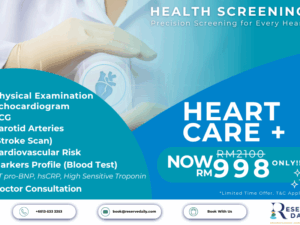
HEART CARE SCREENING
Original price was: RM2,100.00.RM998.00Current price is: RM998.00. per package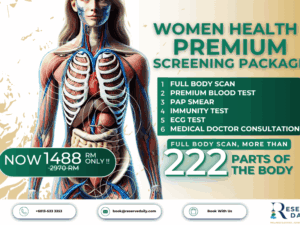
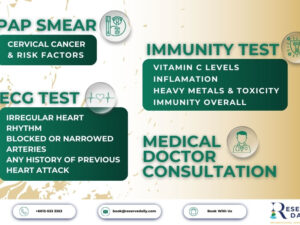
Women Root Cause Screening Package
Original price was: RM2,970.00.RM1,488.00Current price is: RM1,488.00. per session

Cengild G. I. Medical Centre
Price range: RM799.00 through RM1,899.00 per package
