




SPOT-MAS 10 Multi-Cancer Early Detection
RM1,900.00 package
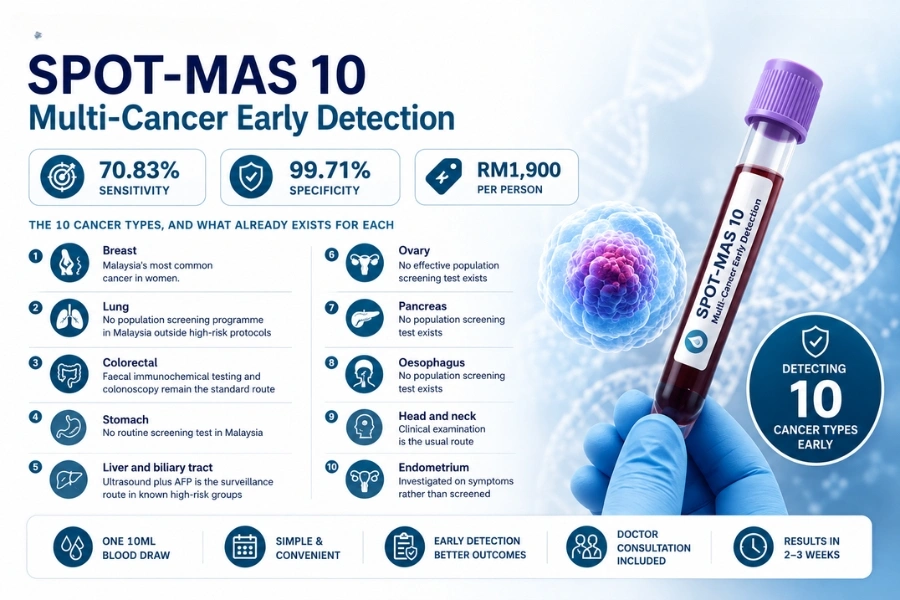
SPOT-MAS 10 is an advanced ctDNA cancer marker test that screens for early signals of ten cancer types from a single, non-invasive blood draw, with tumour-of-origin prediction and a doctor e-consult to guide your next steps.
SPOT-MAS 10 Multi-Cancer Early Detection 10 Cancer Types, One Blood Draw
A multi-cancer early detection blood test reading circulating tumour DNA for signals associated with 10 cancer types, from one 10ml draw with no fasting. The published performance figures, including the one most providers omit, are charted below.
This is an addition to standard screening, not a replacement for any part of it. Mammography, cervical screening and colorectal screening all remain indicated on their usual schedules whatever this test reports.
| Cancer type | Where it sits against standard screening |
|---|---|
| Breast | Malaysia’s most common cancer in women. Mammography remains the population screening test and this does not replace it |
| Lung | No population screening programme in Malaysia outside high-risk protocols |
| Colorectal | Faecal immunochemical testing and colonoscopy remain the standard route |
| Stomach | No routine screening test in Malaysia |
| Liver and biliary tract | Ultrasound plus AFP is the surveillance route in known high-risk groups |
| Ovary | No effective population screening test exists |
| Pancreas | No population screening test exists |
| Oesophagus | No population screening test exists |
| Head and neck | Clinical examination is the usual route |
| Endometrium | Investigated on symptoms rather than screened |
The case for a multi-cancer test is strongest in the rows with no population screening programme, which is 6 of the 10 above. It is weakest for breast and colorectal, where an effective standard test already exists and skipping it in favour of a blood draw would be the wrong trade. That is the honest way to read this chart before spending RM1,900.
| Measure | Figure | What it means for you |
|---|---|---|
| Sensitivity | 70.83% | Of participants who had cancer, roughly 7 in 10 returned a positive signal. Confidence interval 50.83% to 85.09% |
| Specificity | 99.71% | Of participants without cancer, 99.71% correctly returned negative. Confidence interval 99.58% to 99.80% |
| Positive predictive value | 39.53% | Of those who tested positive, fewer than 4 in 10 had cancer. The other 6 went into further investigation without it |
| Negative predictive value | 99.92% | A negative result is reassuring but does not exclude cancer |
| Tissue-of-origin accuracy | 52.94% | When a signal is found, the predicted organ is correct about half the time |
All five figures come from the prospective validation study in asymptomatic adults: Nguyen LHD, et al. BMC Med. 2025;23:90. doi.org/10.1186/s12916-025-03929-y. We publish the positive predictive value because it is the figure that describes what actually happens to someone who tests positive, and quoting a 99.71% specificity without it makes the test look more decisive than the evidence supports. Higher sensitivity figures circulate for this assay from earlier case-control work, where participants were already known to have cancer. The prospective number above is the one that applies to a person booking a screening test.
If you have a symptom now, this is the wrong test. A lump, unexplained weight loss, bleeding or a persistent cough needs clinical assessment and probably imaging, not a screening blood draw reporting in 14 working days.
It is not a substitute for mammography, cervical screening or colorectal screening. Those have population-level evidence behind them and this does not replace any of them.
It is not the right test if a positive result would not be actionable for you. At a positive predictive value of 39.53%, most positives lead to investigations that find nothing, and that is a real cost in money and in anxiety.
How It Works
 1
1 2
2 3
3 4
4Collected at 35 partner centres nationwide and processed by an accredited specialty laboratory under the assay provider’s programme. Every report is read by a doctor registered with the Malaysian Medical Council before the e-consultation. This is a laboratory-developed assay: results are specific to this assay and are not interchangeable with another provider’s multi-cancer test.
SPOT-MAS reads circulating tumour DNA by methylation profile and fragment size and combines those signals with machine-learning models. The figures this page publishes come from the prospective validation in asymptomatic adults (Nguyen LHD, et al. BMC Med. 2025;23:90. doi.org/10.1186/s12916-025-03929-y), which followed an earlier interim report from the same longitudinal cohort (Nguyen LHD, et al. Cancer Invest. 2023;41(3):232 to 248. doi.org/10.1080/07357907.2023.2173773). The wider field behaves the same way: the largest independent validation of a targeted methylation multi-cancer test reported high specificity with sensitivity that rises steeply with cancer stage (Klein EA, et al. Ann Oncol. 2021;32(9):1167 to 1177. doi.org/10.1016/j.annonc.2021.05.806). Two things follow, and both are on this page rather than in a footnote. Early-stage disease sheds less DNA into blood, so the cancers this class of test finds most reliably are not always the ones it would be most valuable to find early. And no multi-cancer early detection assay has yet reported a mortality benefit from a randomised trial, which is the evidence standard that mammography and colorectal screening are held to. This is an additional signal, not a settled screening programme.
Tell us your age, what runs in your family and what you are hoping this will settle. Our care team will walk you through what a positive result would actually mean and what it would cost to follow up, and they will say so if bringing your standard screening up to date is the better use of the money. No obligation, and nobody will chase you.
Frequently Asked Questions
What is multi cancer early detection and what does SPOT-MAS 10 look for?
How accurate is it?
Can it replace my mammogram or colonoscopy?
What happens if the result is positive?
Does a negative result mean I do not have cancer?
Who should consider this test?
How long do results take?
Where can I get it done?
SPOT-MAS 10 Multi-Cancer Early Detection
RM1,900 per person · Signals associated with 10 cancer types · One 10ml blood draw · No fasting · Results in about 14 working days · Doctor e-consultation included · 35 centres across all 13 states
This is a signal-detection test, a positive result is not a finding of cancer, and a normal result does not rule out all disease. Screening is not a substitute for clinical assessment of an active symptom: if you are currently unwell or have a symptom that concerns you, please see a doctor rather than waiting about 14 working days for a result. This test does not replace mammography, cervical screening, colorectal screening or any other established screening programme, and it does not image an organ or biopsy anything. Circulating tumour DNA signals, like tumour markers generally, can be raised for benign reasons and can be absent in the presence of disease. In the prospective validation study the positive predictive value was 39.53%, meaning most positive results were not cancer, and every positive result leads to further investigation. No multi-cancer early detection assay has yet demonstrated a reduction in cancer mortality in a randomised controlled trial. A licensed doctor reviews every report and will advise whether further investigation is needed. Individual results vary and this is a laboratory-developed assay whose results are not comparable with another provider’s test. Samples are processed by an accredited specialty laboratory. Please disclose all medication and supplements, existing medical conditions, any previous cancer diagnosis or treatment, pregnancy or possible pregnancy and recent illness before your appointment.
Explore Health Testing and Diagnostics in Malaysia
Looking for more testing and diagnostic services? Browse our wellness pages:
- Health Screening KL – Comprehensive health check packages
- Blood Test Malaysia – Blood panels and lab diagnostics
- Full Body Checkup Malaysia – Complete health assessments
- Preventive Health Screening KL – Early detection and prevention
- Inflammation Test Malaysia – CRP and inflammatory markers
- Diabetes Screening Malaysia – Blood sugar and HbA1c testing
- Cholesterol Test Malaysia – Lipid panel and cholesterol screening
- Wellness Consultation Malaysia – Pre-test consultations and guidance
Related products




WOMEN CARE HEALTH SCREENING
Original price was: RM1,380.00.RM899.00Current price is: RM899.00. per package
Food Intolerance Test
RM3,800.00 per session
