


HealthIQ Combo Basic Screening
RM360.00 package
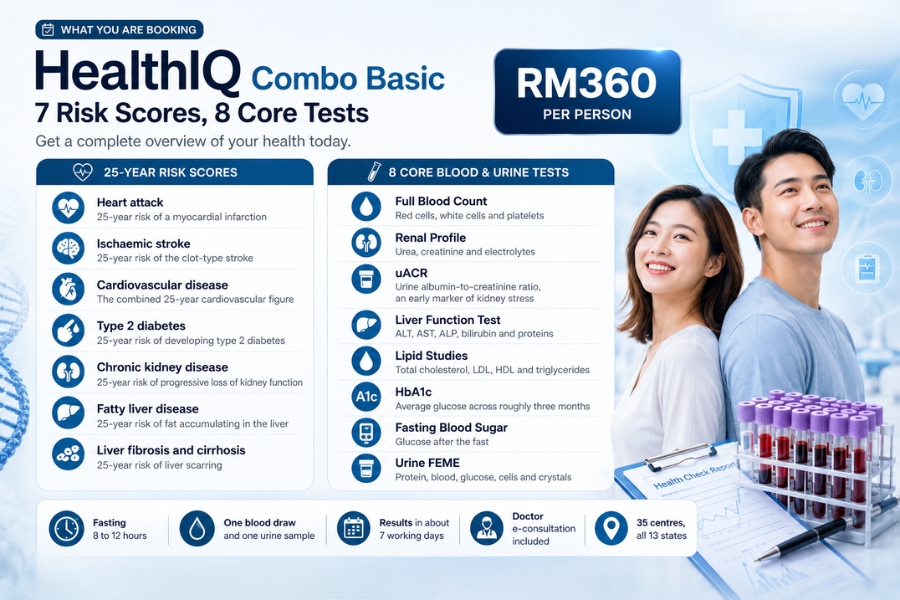
A disease risk screening that turns one blood sample into 25-year risk scores for seven chronic conditions, alongside a full eight-test core panel. Every score and every test is charted below.
HealthIQ Combo Basic Screening 7 Risk Scores, 8 Core Tests
A disease risk screening that turns one blood sample into 25-year risk scores for seven chronic conditions, alongside a full eight-test core panel at RM360. Every score and every test is charted below.
The eight core tests are the same ones a standard screening reports. What this product adds is the modelling layer on top: the same sample is read against large population cohorts to produce a long-horizon risk figure for each of the seven conditions.
| Score or test | What it reads |
|---|---|
| 25-year risk scores · 7 | |
| Heart attack | 25-year risk of a myocardial infarction |
| Ischaemic stroke | 25-year risk of the clot-type stroke |
| Cardiovascular disease | The combined 25-year cardiovascular figure |
| Type 2 diabetes | 25-year risk of developing type 2 diabetes |
| Chronic kidney disease | 25-year risk of progressive loss of kidney function |
| Fatty liver disease | 25-year risk of fat accumulating in the liver |
| Liver fibrosis and cirrhosis | 25-year risk of liver scarring |
| Core blood panel · 8 | |
| Full Blood Count | Red cells, white cells and platelets |
| Renal Profile | Urea, creatinine and electrolytes |
| uACR | Urine albumin-to-creatinine ratio, an early marker of kidney stress |
| Liver Function Test | ALT, AST, ALP, bilirubin and proteins |
| Lipid Studies | Total cholesterol, LDL, HDL and triglycerides |
| HbA1c | Average glucose across roughly three months |
| Fasting Blood Sugar | Glucose after the fast |
| Urine FEME | Protein, blood, glucose, cells and crystals |
A 25-year figure is a population estimate for people whose measurements look like yours. It is not a prediction about you, and it moves when the measurements move, which is the whole point of having a number rather than a reassurance. The eight core tests are also reported as ordinary results with reference ranges, so this replaces a standard screening rather than sitting on top of one.
If you are currently unwell or have a symptom that worries you, this is the wrong instrument. A long-horizon risk score answers a question about the next 25 years, not about this week.
It is not imaging, an ECG, a stress test, a liver scan or a biopsy. Fatty liver and fibrosis risk here are modelled from blood, not visualised.
It contains no markers for cancer, no hormone panel and no infectious disease testing. If that is what you came for, a different product in the range covers it.
How It Works
 1
1 2
2 3
3 4
4Collected at 35 partner centres nationwide and processed by an accredited laboratory under a specialty testing programme. Every report is read by a doctor registered with the Malaysian Medical Council before the e-consultation. The risk scores are generated by the assay provider’s models, and the eight core results carry that laboratory’s reference ranges, so they are comparable within it rather than against another laboratory’s numbers.
Nuclear magnetic resonance spectroscopy quantifies many circulating metabolic measures from one serum sample, and the method and its limits are set out in Wurtz P, et al. Am J Epidemiol. 2017;186(9):1084 to 1096. doi.org/10.1093/aje/kwx016. The scale of the association evidence is largest in the UK Biobank, where 249 NMR biomarkers were mapped against a wide range of disease outcomes in 118,461 people (Julkunen H, et al. Nat Commun. 2023;14(1):604. doi.org/10.1038/s41467-023-36231-7). Two honest caveats belong on this page. First, risk models are only as good as their calibration in the population they are applied to, and a systematic review of cardiovascular prediction models found most were developed and validated in largely European cohorts with limited external validation (Damen JA, et al. BMJ. 2016;353:i2416. doi.org/10.1136/bmj.i2416). Applied to a Malaysian population, a 25-year figure should be read as a relative signal and a tracking tool, not as a calibrated absolute probability. Second, a risk score is not a finding: it describes a group, and the useful information is which of your measurements is driving the number and whether it moves next year.
Tell us your age, what your last blood results looked like and whether heart trouble, diabetes or kidney or liver disease runs in your family. Our care team will tell you whether the modelling layer adds anything for you, and they will say so if a RM126 screening answers your actual question. No obligation, and nobody will chase you.
Frequently Asked Questions
What is disease risk screening and what does HealthIQ report?
How much does it cost in Malaysia?
How is this different from a standard health screening?
How accurate is a 25-year risk score?
Do I need to fast?
Does this test for cancer?
How long do results take?
Where can I get it done?
HealthIQ Combo Basic Screening
RM360 per person · 7 chronic disease risk scores plus 8 core tests · 8 to 12 hour fast · Results in about 7 working days · Doctor e-consultation included · 35 centres across all 13 states
Risk scores are population estimates for people whose measurements resemble yours, they are not a statement about what will happen to you, and a normal result does not rule out all disease. Screening is not a substitute for clinical assessment of an active symptom: if you are currently unwell, please see a doctor rather than waiting about 7 working days for a result. This panel does not replace imaging, an ECG, a stress test, liver elastography or a biopsy, and it does not image an organ, read a heart rhythm or biopsy anything. It contains no markers for cancer and it is not a cancer screening test. Risk models are calibrated in the cohorts in which they were developed, most large cardiovascular models having been built in largely European populations, so absolute figures should be read with that in mind. A licensed doctor reviews every report and will advise whether further investigation is needed. Reference ranges and individual results vary, and results are not directly comparable between laboratories. Samples are processed by an accredited laboratory. Please disclose all medication and supplements, existing medical conditions, pregnancy or possible pregnancy and recent illness before your appointment.
Explore Health Testing and Diagnostics in Malaysia
Looking for more testing and diagnostic services? Browse our wellness pages:
- Health Screening KL – Comprehensive health check packages
- Blood Test Malaysia – Blood panels and lab diagnostics
- Full Body Checkup Malaysia – Complete health assessments
- Preventive Health Screening KL – Early detection and prevention
- Inflammation Test Malaysia – CRP and inflammatory markers
- Diabetes Screening Malaysia – Blood sugar and HbA1c testing
- Cholesterol Test Malaysia – Lipid panel and cholesterol screening
- Wellness Consultation Malaysia – Pre-test consultations and guidance
Related products
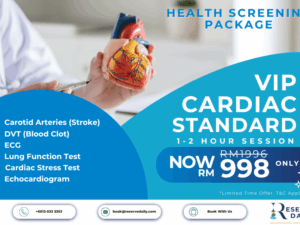
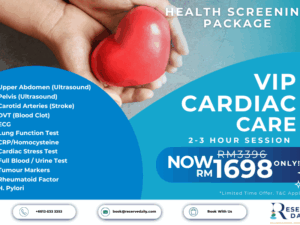
VIP CARDIAC HEALTH SCREENING
Price range: RM998.00 through RM2,298.00 per package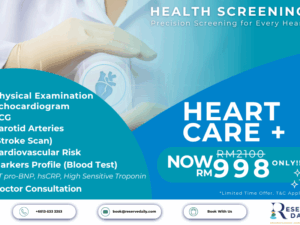
HEART CARE SCREENING
Original price was: RM2,100.00.RM998.00Current price is: RM998.00. per package
WOMEN CARE HEALTH SCREENING
Original price was: RM1,380.00.RM899.00Current price is: RM899.00. per package
Food Intolerance Test
RM3,800.00 per session