




Heart and Cardiovascular Risk Blood Test
RM428.00 package
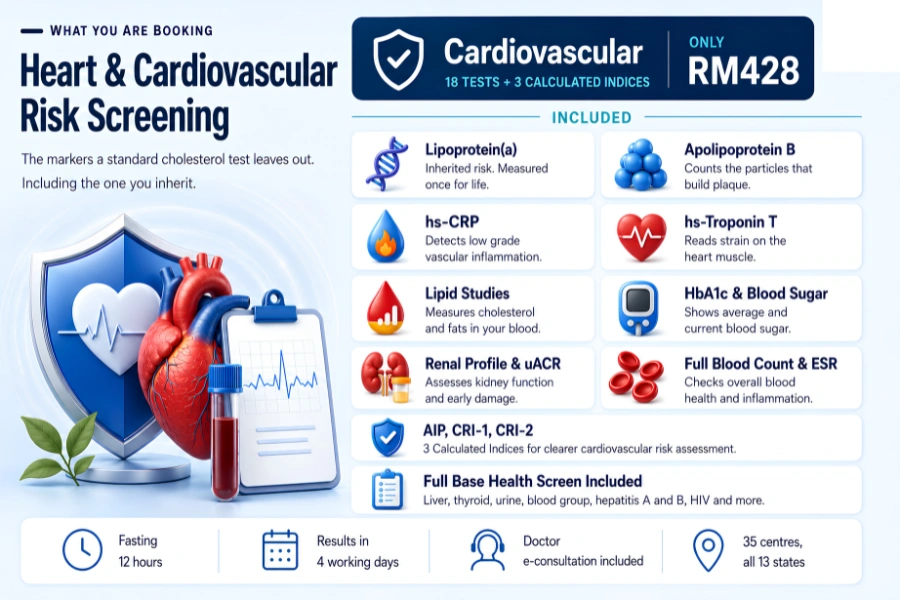
This is a heart disease risk test Malaysia adults are rarely offered. The Heart and Cardiovascular Risk Blood Test measures exactly what is listed in the test chart on this page, and you can book it directly via WhatsApp.
Heart and Cardiovascular Risk Blood Test
This is a heart disease risk test Malaysia adults are rarely offered: one blood draw covering the inherited and inflammatory markers a standard cholesterol result leaves out. It includes Lipoprotein(a), a number most people never have measured and only ever need measured once.
hs-Troponin T
Apolipoprotein B
12 hour fast
Doctor e-consult included
A standard lipid panel measures how much cholesterol you carry. It does not measure how many particles carry it, whether your arteries are inflamed, or what you inherited. A person can score well on the first while the other two sit unread. That is the situation this panel is built for, someone whose numbers came back fine and whose family history says otherwise.
Lipoprotein(a) is the clearest example. It is set largely by your genes, stays broadly stable through adult life, and is not moved much by diet or the usual cholesterol medicines. Because it does not change, it is measured once and the result is yours for life. It is also not part of routine screening in Malaysia, so most adults have no idea what their number is. This is a screening panel and not a diagnosis: it describes risk rather than confirming or excluding disease.
01

Measured once, valid for life
02

ApoB particle count
03

hs-CRP
04

hs-Troponin T
05

AIP, CRI-1, CRI-2
06

uACR
19 test groups


The full panel, grouped by what it looks at. The first four are the cardiovascular markers that distinguish this panel. The rest is a complete base health screen taken from the same draw.
| Test | What it measures | What it can tell you |
|---|---|---|
| Cardiovascular markers | ||
| Lipoprotein(a) | A cholesterol carrying particle whose level is set mainly by your genes. | Whether inherited risk is present. Stable through life, so one measurement is generally enough. |
| Apolipoprotein B | The number of atherogenic particles in circulation, rather than the cholesterol inside them. | Whether particle burden is higher than an LDL result alone suggests. |
| High sensitivity CRP | A general inflammation protein, read at concentrations a standard CRP cannot detect. | Whether low grade inflammation is present. Also rises with infection, so timing matters. |
| High sensitivity Troponin T | A protein released by heart muscle, measurable at very low concentrations. | Whether there is ongoing cardiac strain. In screening this is a trend marker, not an emergency test. |
| Lipids and calculated indices | ||
| Lipid Studies | Total cholesterol, triglycerides, HDL, LDL, non-HDL and the total to HDL ratio. | The conventional cholesterol picture, and the base for the three indices below. |
| AIP | Atherogenic Index of Plasma, calculated from triglycerides and HDL. | A single ratio summarising lipid balance. No additional blood needed. |
| CRI-1 and CRI-2 | Castelli Risk Index 1 and 2, ratios of total and LDL cholesterol to HDL. | How your cholesterol is distributed, which raw totals can obscure. |
| Organ function and metabolic | ||
| uACR | Albumin to creatinine ratio in urine. | Early kidney and small vessel damage, often before symptoms appear. |
| HbA1c and Fasting Blood Sugar | Average blood sugar over about three months, and glucose on the day. | Whether blood sugar is contributing to vascular risk. |
| Renal Profile | Kidney function markers and electrolytes. | How the kidneys are coping, the organ most affected by long term blood pressure. |
| Liver Function Test | Liver enzymes, proteins and bilirubin. | Liver status, which is checked before and during cholesterol medication. |
| Thyroid Stimulating Hormone | The pituitary signal that regulates thyroid activity. | Whether thyroid function is affecting cholesterol or heart rate. |
| General base screen, same draw | ||
| Full Blood Examination with ESR | Red cells, white cells with differential, platelets, and sedimentation rate. | Anaemia, infection, and a second general inflammation reading. |
| Urine FEME | Protein, blood, glucose and sediment in urine. | Urinary tract and kidney signals alongside the uACR. |
| ABO blood group | Your blood group. | Useful to have on record. Not a risk marker. |
| Rheumatoid Factor | An antibody associated with some inflammatory joint conditions. | A general inflammatory signal. Needs clinical interpretation, not read alone. |
| RPR, hepatitis A and B, HIV, AFP | Infectious disease serology, plus alpha fetoprotein. | Standard inclusions in the base tier. Not cardiovascular, included because the panel is built on it. |
Reference ranges vary by laboratory and are printed on your report. A result outside a range is a reason to discuss it with your doctor, not a diagnosis on its own.
+RM60
+RM100
+RM176

1

2
3

4
Built for the person whose cholesterol came back acceptable but whose family history did not.

A parent or sibling had a heart attack or stroke before 60
Your cholesterol was called normal and you were not reassured
You are over 35 and have never had Lipoprotein(a) measured
You take a statin and want to see what it is not addressing
You have high blood pressure or blood sugar and want the vascular picture
You want one baseline to measure against in future years- Not for you if you have chest pain or breathlessness now. That is an emergency assessment. Go to a hospital rather than book a test
- Not for you if you want a diagnosis. This panel describes risk and does not confirm or exclude heart disease
The four cardiovascular markers in this panel are established subjects of cardiology research. The references below are provided so you can read the source material yourself. They describe the markers, and are not evidence of any outcome from taking this test.
Kronenberg F et al. Lipoprotein(a) in atherosclerotic cardiovascular disease and aortic stenosis: a European Atherosclerosis Society consensus statement. European Heart Journal 2022;43(39):3925-3946. doi.org/10.1093/eurheartj/ehac361
Sniderman AD et al. Apolipoprotein B Particles and Cardiovascular Disease. JAMA Cardiology 2019;4(12):1287. doi.org/10.1001/jamacardio.2019.3780
Willeit P et al. High-Sensitivity Cardiac Troponin Concentration and Risk of First-Ever Cardiovascular Outcomes in 154,052 Participants. Journal of the American College of Cardiology 2017;70(5):558-568. doi.org/10.1016/j.jacc.2017.05.062
Ridker PM et al. Rosuvastatin to Prevent Vascular Events in Men and Women with Elevated C-Reactive Protein. New England Journal of Medicine 2008;359(21):2195-2207. doi.org/10.1056/NEJMoa0807646
Heart disease risk test Malaysia: what does this panel measure?

Why measure Lipoprotein(a) if I already know my cholesterol?
Do I need to fast before this test?
How long do results take?
Can this test tell me if I am going to have a heart attack?
I am already taking a statin. Is this still worth doing?
Is the doctor consultation included?
Ujian ini untuk siapa?
This screening panel is provided for health information purposes and does not constitute medical diagnosis, treatment or advice. Screening is not diagnosis. A result outside the reference range requires clinical follow up with a qualified doctor, and a result within the reference range does not exclude cardiovascular disease. This panel does not replace an ECG, stress testing, imaging or specialist cardiology assessment. The research cited above describes the markers measured and is not evidence of any outcome from taking this test. If you are currently experiencing chest pain, breathlessness, palpitations or other acute symptoms, seek emergency medical care rather than booking a screening test. Always consult a qualified healthcare professional before making decisions about medication or treatment.
Related products



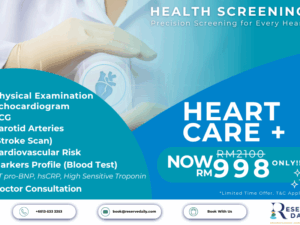
HEART CARE SCREENING
Original price was: RM2,100.00.RM998.00Current price is: RM998.00. per package
Men Root Cause Screening Package
Original price was: RM2,895.00.RM1,488.00Current price is: RM1,488.00. per session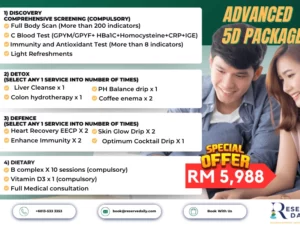
Comprehensive Wellness Screening and Detox Package
RM5,988.00 per package
