


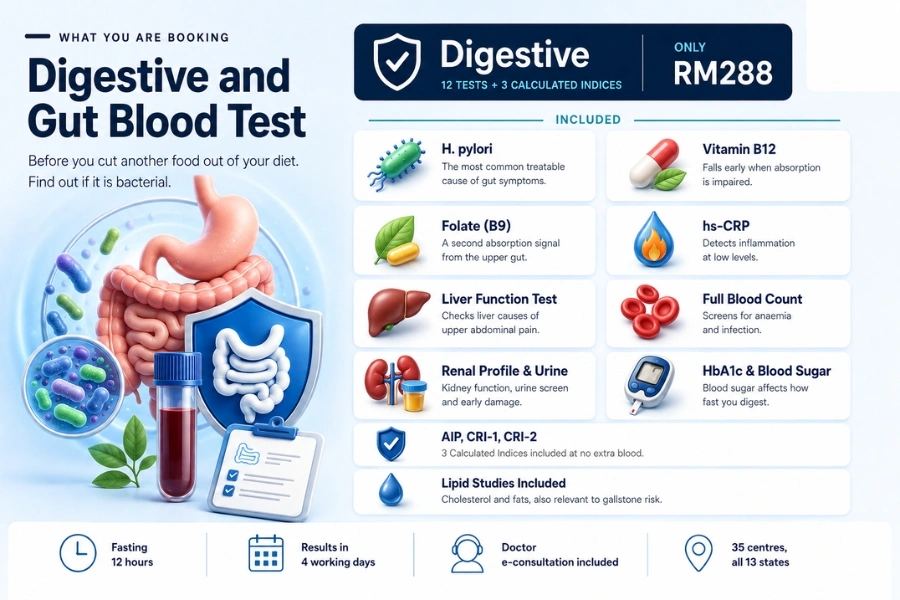


Digestive and Gut Blood Test
RM288.00 package
Checks for H. pylori, the nutrients poor absorption drains first, and whether inflammation is present. The Digestive and Gut Blood Test measures exactly what is listed in the test chart on this page, and you can book it directly via WhatsApp.
Digestive and Gut Blood Test
A bloating blood test Malaysia adults can book without a referral, built around the one infection that explains most upper gut symptoms here. It checks for H. pylori, the nutrients poor absorption drains first, and whether inflammation is present.
B12 and Folate
hs-CRP
12 hour fast
Doctor e-consult included
See exactly what every test measures
Results are reviewed by a doctor before they reach you.
Most people with ongoing gut symptoms change their diet before anyone measures anything. They cut dairy, then gluten, then coffee, and after a few months they have a shorter menu and the same symptoms. The problem is that bloating, discomfort after meals and irregular digestion all feel the same from the inside, whatever is causing them.
The most common treatable cause in Malaysia is a bacterial infection, not a food. Helicobacter pylori lives in the stomach lining, is widespread in this region, and is straightforward to test for and to treat. This panel checks for it directly, then looks at the nutrients that poor absorption depletes first and whether there is inflammation. This is a screening panel and not a diagnosis: it narrows the question rather than settling it.
01

H. pylori antibody
02

B12 and Folate
03

hs-CRP
04

Liver Function Test
05

Full Blood Count
06

HbA1c and glucose
15 test groups


The full panel, grouped by what it looks at. The first four are the digestive markers that distinguish this panel. The rest is a complete base health screen taken from the same draw.
| Test | What it measures | What it can tell you |
|---|---|---|
| Digestive markers | ||
| Helicobacter pylori | Antibodies to a bacterium that colonises the stomach lining. | Whether an infection widespread in this region is present. It is treatable, so a positive result is actionable. |
| Vitamin B12 | Circulating B12, absorbed in the lower small intestine. | Whether absorption is impaired. Also affects energy and nerve function independently. |
| Folate (B9) | Circulating folate, absorbed in the upper small intestine. | A second absorption signal from a different part of the gut, which helps localise a problem. |
| High sensitivity CRP | A general inflammation protein at low concentrations. | Whether inflammation is present. Also rises with any infection, so timing matters. |
| Organ function | ||
| Liver Function Test | Liver enzymes, proteins and bilirubin. | Whether liver or biliary problems explain upper abdominal symptoms, which are easily mistaken for digestive ones. |
| Full Blood Count | Red cells, white cells and platelets. | Anaemia, which can accompany long running gut problems, and signs of infection. |
| Renal Profile | Kidney function markers and electrolytes. | Whether prolonged symptoms have affected hydration or electrolyte balance. |
| Urine FEME and uACR | Protein, blood, glucose and sediment in urine, plus albumin to creatinine ratio. | Urinary tract infection, which can present as lower abdominal discomfort, and early kidney damage. |
| Metabolic, same draw | ||
| HbA1c and Fasting Blood Sugar | Average blood sugar over about three months, and glucose on the day. | Whether blood sugar is affecting how quickly the stomach empties, which changes fullness after meals. |
| Lipid Studies | Total cholesterol, triglycerides, HDL, LDL and non-HDL. | General cardiovascular picture, and relevant to gallstone risk. |
| AIP, CRI-1, CRI-2 | Three ratios calculated from your lipid results. | Lipid balance expressed as ratios. No additional blood required. |
Reference ranges vary by laboratory and are printed on your report. A result outside a range is a reason to discuss it with your doctor, not a diagnosis on its own.
+RM120
+RM12
Separate panel

1

2
3

4
Built for the person who has already started cutting foods out without knowing what they are looking for.

You are bloated or uncomfortable after most meals
You have started eliminating foods and it has not settled anything
You get burning, reflux or upper stomach pain
Someone in your household has had H. pylori
You are tired as well as bloated, and wonder if the two are connected
You want to know what is going on before you see a specialist- Not for you if you have blood in your stool, are vomiting repeatedly, cannot swallow, or are losing weight without trying. See a doctor now rather than booking a screening test
- Not for you if you want a diagnosis. This panel narrows the question and does not settle it
The markers in this panel are established subjects of gastroenterology research. The references below are provided so you can read the source material yourself. They describe the markers, and are not evidence of any outcome from taking this test.
Hooi JKY et al. Global Prevalence of Helicobacter pylori Infection: Systematic Review and Meta-Analysis. Gastroenterology 2017;153(2):420-429. doi.org/10.1053/j.gastro.2017.04.022
Malfertheiner P et al. Management of Helicobacter pylori infection: the Maastricht VI/Florence consensus report. Gut 2022;71(9):1724-1762. doi.org/10.1136/gutjnl-2022-327745
Green R et al. Vitamin B12 deficiency. Nature Reviews Disease Primers 2017;3:17040. doi.org/10.1038/nrdp.2017.40
Vermeire S, Van Assche G, Rutgeerts P. Laboratory markers in IBD: useful, magic, or unnecessary toys? Gut 2006;55(3):426-431. doi.org/10.1136/gut.2005.069476
Bloating blood test Malaysia: what does this panel actually check?

Will this tell me which foods I am reacting to?
What is H. pylori and why test for it?
Do I need to fast before this test?
How long do results take?
Does this replace an endoscopy?
Is the doctor consultation included?
Ujian ini untuk siapa?
This screening panel is provided for health information purposes and does not constitute medical diagnosis, treatment or advice. Screening is not diagnosis. A result outside the reference range requires clinical follow up with a qualified doctor, and a result within the reference range does not exclude a digestive condition. This panel does not replace endoscopy, colonoscopy, stool testing, imaging or specialist gastroenterology assessment. Serology indicates exposure to Helicobacter pylori and confirmation of active infection may require further testing, which your doctor will advise on. If you have blood in your stool, persistent vomiting, difficulty swallowing, or unintentional weight loss, seek medical care rather than booking a screening test. Always consult a qualified healthcare professional before making decisions about medication or treatment.
Related products



Allergy Screening Packages
Price range: RM450.00 through RM998.00 package



GENETIC TESTING PACKAGE
Price range: RM1,588.00 through RM4,388.00 per package

VIP CARDIAC HEALTH SCREENING
Price range: RM998.00 through RM2,298.00 per package
