


Food Intolerance Test (IgG)
From RM500.00 package
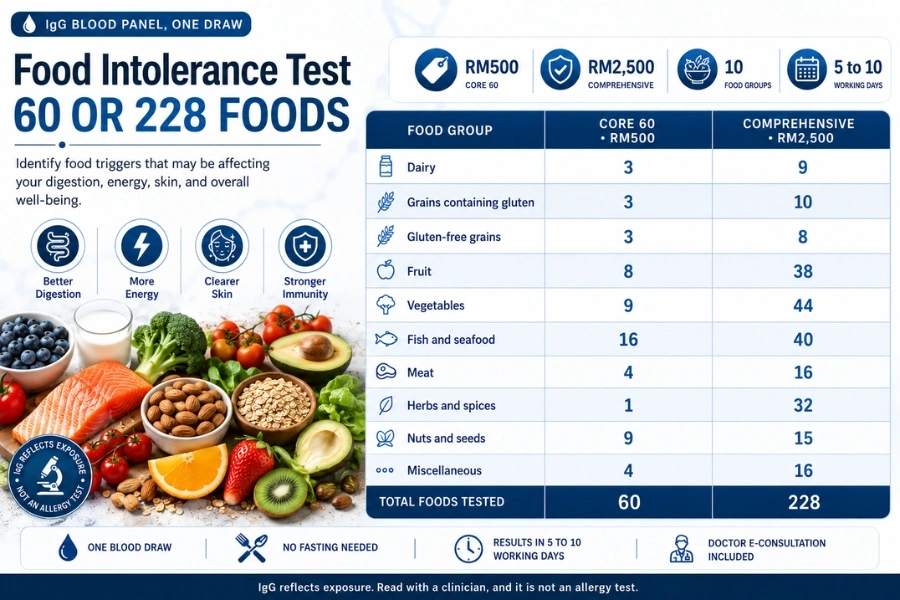
Every food group and its count is charted below, 60 or 228 foods, 10 food groups
Food Intolerance Test (IgG) 60 Or 228 Foods, One Draw
A food intolerance test in Malaysia measuring IgG antibodies against 60 or 228 individual foods from a single blood draw. Every food group and its count is charted below, and so is the honest limitation of the method.
Same method, same sample, same reporting time. The only difference is how many foods are on the list, and the chart below shows exactly where the extra 168 sit.
| Food group | Core 60 | Comprehensive |
|---|---|---|
| Dairy | 3 | 9 |
| Grains containing gluten | 3 | 10 |
| Gluten-free grains | 3 | 8 |
| Fruit | 8 | 38 |
| Vegetables | 9 | 44 |
| Fish and seafood | 16 | 40 |
| Meat | 4 | 16 |
| Herbs and spices | 1 | 32 |
| Nuts and seeds | 9 | 15 |
| Miscellaneous | 4 | 16 |
| Total foods tested · 60 and 228 | ||
Counts are individual foods, not groups. Core 60 covers 60 foods and Comprehensive covers 228, which is where the page’s older “200 plus” figure comes from. The two biggest jumps are herbs and spices, 1 food to 32, and vegetables, 9 to 44. If your suspicion is a specific spice or a specific vegetable, that is the difference you are paying for. If it is dairy, wheat or seafood, Core 60 already covers the common ones.
This is not an allergy test. Food allergy is IgE-mediated and can be immediate and dangerous. If a food has ever caused swelling, hives, wheeze or collapse, you need the IgE allergy panel and a doctor, not this.
It is not a coeliac test. Coeliac disease is investigated with tissue transglutaminase antibodies and, where indicated, biopsy.
It is not an instruction to cut foods out. A raised IgG level frequently reflects how often you eat something rather than a problem with it, which is why every result goes through the e-consultation before anything changes on your plate.
How It Works
 1
1 2
2 3
3 4
4Collected at 35 partner centres nationwide and processed by an accredited laboratory under a specialty testing programme. Every report is read by a doctor registered with the Malaysian Medical Council before the e-consultation. IgG units are assay-specific, so a level from this panel is only comparable with another level from the same panel.
Food-specific IgG is a measure of exposure and immune memory, and the professional bodies are unambiguous that it is not diagnostic for food intolerance or food allergy. The European Academy of Allergy and Clinical Immunology Task Force concluded that food-specific IgG4 should not be used for that purpose (Stapel SO, et al. Allergy. 2008;63(7):793 to 796. doi.org/10.1111/j.1398-9995.2008.01705.x), and the Canadian Society of Allergy and Clinical Immunology reached the same position (Carr S, et al. Allergy Asthma Clin Immunol. 2012;8(1):12. doi.org/10.1186/1710-1492-8-12). Immediate-type food reactions are IgE-mediated and are investigated with specific IgE instead (Ansotegui IJ, et al. World Allergy Organ J. 2020;13(2):100080. doi.org/10.1016/j.waojou.2019.100080). We publish this rather than bury it: the usable role for an IgG panel is as a structured starting list for a supervised elimination and reintroduction trial, where the trial, not the antibody level, is what tells you anything. If nobody is going to supervise that trial, the panel will not answer your question and we would rather say so before you pay for it.
Tell us what happens, how long after eating, and whether it has ever involved swelling, hives or breathing. Our care team will tell you whether the IgG panel, the IgE allergy panel or a doctor first is the sensible order, and they will say so if the answer is none of the three. No obligation, and nobody will chase you.
Frequently Asked Questions
What is a food intolerance test in Malaysia and what does it measure?
How much does a food intolerance test cost?
Which panel should I choose, Core 60 or Comprehensive?
Is a food intolerance test the same as an allergy test?
Is IgG food testing scientifically reliable?
Do I need to fast before the test?
How long do results take?
Where can I get this done?
Food Intolerance Test (IgG)
RM500 for 60 foods or RM2,500 for 228 · One blood draw · No fasting needed · Results in 5 to 10 working days · Doctor e-consultation included · 35 centres across all 13 states
IgG food testing is a screening tool, it is not a test for food allergy, and a normal result does not rule out all disease. Screening is not a substitute for clinical assessment of an active symptom: if you are currently unwell, please see a doctor rather than waiting 5 to 10 working days for a result. This panel does not replace investigation for coeliac disease, inflammatory bowel disease or IgE-mediated food allergy, and it does not image or biopsy anything. A raised IgG result may reflect normal exposure to foods eaten regularly and does not by itself confirm an intolerance. Do not remove foods from your diet, or from a child’s diet, based on these results without consulting a qualified healthcare professional, as unsupervised dietary restriction carries nutritional risk. A licensed doctor reviews every report and will advise whether further investigation is needed. Reference ranges and individual results vary, and IgG assays are not directly comparable between laboratories. Samples are processed by an accredited laboratory. Please disclose all medication and supplements, existing medical conditions, pregnancy or possible pregnancy and recent illness before your appointment.
Explore Health Testing and Diagnostics in Malaysia
Looking for more testing and diagnostic services? Browse our wellness pages:
- Health Screening KL – Comprehensive health check packages
- Blood Test Malaysia – Blood panels and lab diagnostics
- Full Body Checkup Malaysia – Complete health assessments
- Preventive Health Screening KL – Early detection and prevention
- Inflammation Test Malaysia – CRP and inflammatory markers
- Diabetes Screening Malaysia – Blood sugar and HbA1c testing
- Cholesterol Test Malaysia – Lipid panel and cholesterol screening
- Wellness Consultation Malaysia – Pre-test consultations and guidance